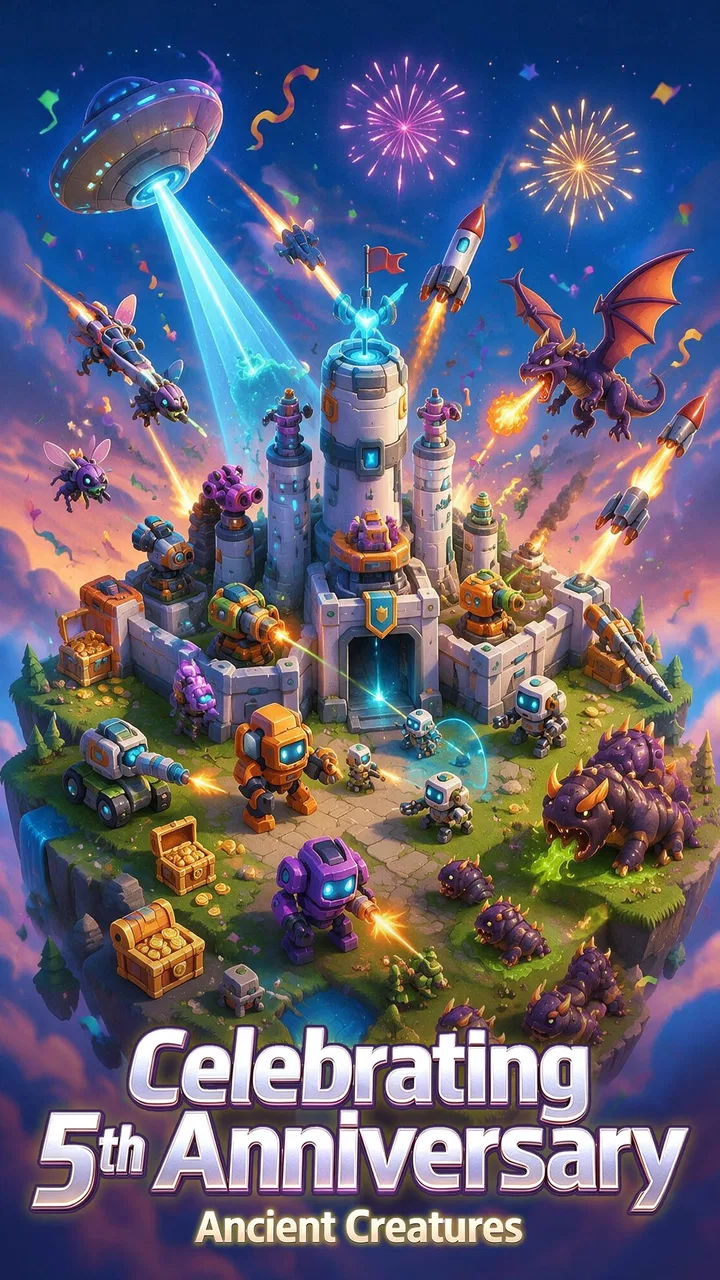
Mega Tower - Casual TD Game
- 3.4
- Rating
- 5.00M
- Installs
- Free
- Price

 Analysis by App-foxy
I spent time with Mega Tower - Casual TD Game as an arcade title built around defending, attacking, and making decisions with a guild-minded approach. It comes from YOULOFT GAMES, is free to start, and is aimed at players aged Everyone 10+. My first impression was that it wants to make tower defense feel quicker and more social than a purely solo strategy game. You are not simply placing defenses and waiting for a wave to end; the appeal comes from choosing how to strengthen your position, reacting to pressure, and treating each battle as part of a wider competitive routine.
That combination makes it easy to understand within a short session. I could pick it up when I had only a few minutes, but there was still enough decision-making to make victory feel earned. The game is not trying to replace a deep, slow strategy experience with a huge number of systems. Instead, it focuses on the satisfying arcade loop of building power, surviving threats, and pushing toward the next challenge. If you enjoy compact battles and the idea of progressing alongside guild members, it has a clear reason to exist.
How the current version feels to play
The current version is 4.5.2, and that matters because Mega Tower feels like an established game rather than a first draft. The basic presentation is easy to approach: battles are the center of attention, upgrades and preparation support those battles, and the broader galaxy theme gives the arcade action a sense of direction. I did not need a long explanation to understand what I was supposed to do, which is valuable on a phone where complicated menus can make a casual game feel like work.
You May Also Like

 Blood Strike: 2.5 Anniversary
Blood Strike’s Loadouts Turn Every Drop Into a Tactical Gamble
A close look at Blood Strike’s custom loadouts: how fast access to signature weapons reshapes its battle royale rhythm, rewards preparation, and narrows the gap between fights.

 Pandora - Music & Podcasts
Pandora’s Music Is Easy to Start, but Harder to Recover
Pandora’s strength is its low-effort path from a seed to a station. Its weak spot is how much confidence it asks you to place in connection, setup, and quiet recovery.

 8 Ball Pool
 Is Built on Rivalries, Rematches, and Routine
A close look at the rivalries, rematches, shared routines, and unanswered safety questions that turn a quick pool match into a persistent mobile community.

 Samsung Music
’s Quiet Strength Is Playing What You Already Own
Its reach comes less from spectacle than from dependable access to a personal library. That simplicity is both the app’s strongest retention engine and its ceiling.

 AccuWeather: Weather Radar
AccuWeather Review: A Quick, Clear Forecast for Everyday Decisions
For everyday plans, the best forecast is the one you can understand quickly. AccuWeather makes rain timing, radar, and local conditions easy to act on, with a few trade-offs.

 Hill Climb Racing
Why Hill Climb Racing Still Turns Crashes Into One More Run
A tiny car, a bumpy hill and one more upgrade: Hill Climb Racing keeps resurfacing because its simple chaos makes every near-miss feel personal.
More From Our News Desk



The best part of the experience is the rhythm between preparation and action. Before a fight, I naturally think about whether I should improve my immediate strength or save resources for a more important upgrade. During a battle, that earlier choice becomes visible. A strong setup can make a difficult encounter feel controlled, while a careless investment can leave me scrambling. That relationship between planning and quick reaction gives the game more personality than an arcade title that only asks me to tap through repeated encounters.
Guild play also changes the mood. A completely solo tower-defense game can become a private optimization exercise, but the guild angle gives progress a social context. Players who like checking in, contributing to a shared effort, or comparing their performance with other people will probably find more reason to return. I would not describe it as a substitute for a full multiplayer strategy game, though. Its appeal is closer to having a cooperative layer around accessible battles than to managing a detailed online war.
The game has reached more than five million installs, which suggests that its compact format has found a sizeable audience. Its average rating sits at 3.4 from about sixty-nine thousand ratings, while roughly three and a half thousand written reviews provide a more mixed picture than the install count alone. I read that combination as a useful warning: Mega Tower clearly attracts players, but it will not satisfy everyone who downloads it. The people most likely to enjoy it are those who accept a free-to-play arcade structure and want regular, manageable sessions rather than an endlessly deep simulation.
The progression loop rewards attention more than rushing
One of my more useful discoveries was that it is tempting to treat every reward as permission to spend immediately. That approach can make early progress feel comfortable, but it can also leave me without flexibility when the game asks for a stronger response. I had better results when I paused after a successful battle and considered which improvement would solve a recurring problem rather than simply raising a number that already looked attractive.
This is a small distinction, but it changes how the game feels. Mega Tower is more enjoyable when I treat upgrades as answers to specific weaknesses. If my defenses are regularly overwhelmed, I should not automatically chase the most visible reward. I should first ask whether I am improving the part of my setup that actually causes the loss. That habit makes the game feel more strategic without requiring a complicated spreadsheet or a long planning session.
Another practical tip is to avoid judging a battle only by whether it was won. A narrow victory can reveal that my current approach is fragile, even if the reward screen looks positive. I found it more useful to notice which stage of a fight caused trouble and then adjust around that moment. This is especially important for players who like steady progress: repeating the same setup may work for a while, but it can become inefficient when the challenge changes.
The arcade structure helps here because experimentation does not feel as intimidating as it would in a large strategy game. I can try a different approach, see how it performs, and decide whether it deserves further investment. That makes the title suitable for players who enjoy learning through short attempts. It is less suitable for someone who wants every decision to have a clearly explained, long-term consequence before pressing a button.
What guild involvement adds to everyday play
The guild focus is most useful when it becomes part of a routine rather than something I remember only after a difficult loss. A realistic use case is a short evening check-in: I can play a few battles, review what needs improvement, and see whether my contribution fits the group’s current activity. That gives the game a reason to stay installed after the novelty of the first battles fades.
There is also a social trade-off. Guild-oriented play can make progress feel more meaningful, but it may create pressure for people who prefer to play entirely at their own pace. If you dislike shared goals, rankings, or the feeling that other players are part of your daily schedule, the social layer may not improve the experience for you. I would choose a more relaxed solo arcade game in that situation, especially if I wanted something with no expectation of regular participation.
For players who do enjoy guilds, my advice is to approach the feature as a bonus rather than the only reason to play. The battles need to remain enjoyable on their own. If the core loop is not satisfying, social progress will not fix that for long. In my experience, the strongest reason to keep returning is the combination of a battle that asks for a better decision and a group context that makes that improvement feel worthwhile.
Free to play, with a clear spending decision
Mega Tower is free to download and play, but it includes in-app purchases ranging from $0.99 to $99.99 per item. That wide range is important for anyone deciding whether it belongs on a family device or on a phone where spending needs to be tightly controlled. The game is not automatically a bad choice because purchases exist, but I would recommend setting a personal limit before getting deeply involved in progression.
I found the most comfortable way to approach it was to treat purchases as optional acceleration rather than part of the basic admission price. If I am enjoying the battles, I can continue evaluating the game without immediately spending. If I feel that progress is becoming frustrating only because I am refusing to pay, that is a useful signal to step back. A free-to-start game should fit my budget and my patience, not quietly redefine both.
This is also where the game differs from traditional paid arcade titles. A paid alternative may offer a simpler relationship between play and progress, while Mega Tower gives me a free entry point and a more ongoing structure. The choice depends on what I value. I would prefer this model if I want to test the core loop before committing money. I would prefer a paid game if I want a self-contained experience with fewer spending decisions around progression.
Parents should also keep the Everyone 10+ rating in mind and discuss purchases before handing the game to a younger player. The rating makes it broadly approachable, but the presence of optional items still means the financial side deserves attention. That is not a criticism of the battle design itself; it is simply part of using a free arcade game responsibly.
How it compares with other tower-defense choices
Compared with a classic solo tower-defense game, Mega Tower feels more focused on the ongoing journey and the social setting than on building one perfectly balanced map. I would choose it when I want quick decisions, repeated progression, and a reason to check back in. I would choose a more traditional alternative when I want carefully designed stages, slower tactical planning, or a campaign that feels complete without guild participation.
It also differs from a pure idle game. There is still a sense of active involvement because battles and choices matter, so it is not ideal if I want to leave the phone alone and collect rewards later. At the same time, it does not demand the constant attention of a real-time competitive game. That middle position is one of its strengths: I can engage with it actively for a short period without needing to treat every session as a major commitment.
Against other casual arcade games, Mega Tower has more structure than a simple score-chasing title. The galaxy setting, guild concept, and upgrade loop give my actions some continuity. The downside is that players who prefer instant variety may find the progression routine repetitive. A quick arcade game with one-minute rounds may be a better fit if I want novelty rather than development of a single account over time.
Where the current experience still has friction
The rating of 3.4 shows that the game has a meaningful group of players who are not completely satisfied, and my own experience helps explain why that can happen. The progression loop is easy to enter, but its appeal depends heavily on whether repeated battles continue to feel like decisions instead of chores. Once I understand a reliable approach, the challenge can feel less surprising. Players who need constant mechanical variety may lose interest before the larger progression has time to matter.
The free-to-play structure can add another layer of friction. Even when I choose not to buy anything, the existence of purchasable acceleration changes how I interpret slow progress. I start asking whether I am being challenged to improve or simply being encouraged to wait or spend. That uncertainty is common in this category, but it still affects the experience. Mega Tower works best for people who can enjoy gradual progress without feeling compelled to optimize every delay.
There is also a difference between social motivation and social dependence. Guilds can make a routine more engaging, but they cannot guarantee that every player will find a comfortable group or a satisfying level of activity. Someone looking for a deeply coordinated team game may find the social layer lighter than expected. Someone who wants a private game may find it more prominent than necessary. Before downloading, I would decide which of those two preferences is closer to my own.
Device compatibility is fairly approachable because the game requires Android 7.0 or later. That makes it a practical option for people who are not using the newest phone, although actual comfort will still depend on the device and the player’s tolerance for menus, effects, and longer sessions. I would install it on an older phone as a test rather than assuming that an operating-system requirement tells the whole story.
Who should play it, and who should skip it
I recommend Mega Tower to casual strategy fans who want a free starting point, short battle sessions, and a guild element that gives progress some social meaning. It is particularly suitable for someone who likes improving a setup gradually and does not mind returning to familiar systems. The game can also work for a player who is new to tower defense because it does not demand the intimidating level of planning found in more elaborate strategy titles.
I would skip it if I want a fully premium experience, a story-led campaign, or a game where every major feature is available without considering purchases. I would also look elsewhere if my favorite part of tower defense is designing intricate solutions on a fixed map. Mega Tower is more about maintaining momentum across an ongoing arcade progression than about solving one elaborate puzzle with absolute precision.
Players who dislike guild expectations should be cautious as well. The title can still be approached for its battles, but the social direction is part of its identity, not a decorative menu. Likewise, people who become frustrated by gradual free-to-play progression should decide in advance whether they are comfortable remaining patient. That simple self-check will tell you more than the store summary does.
What the version history means for returning players
Seeing version 4.5.2 tells me that the game has continued beyond its initial release, which was on January 15, 2021. For a returning player, that is encouraging because the current experience is not necessarily identical to the one remembered from launch. The sensible approach is to treat the present version as its own product: revisit the menus, reassess the progression rhythm, and avoid assuming that an old strategy still fits perfectly.
At the same time, a version number by itself is not a promise that every personal complaint has been solved. Existing users should look for practical improvements in how smoothly they can move from battle to upgrade to guild activity. If that routine feels clearer and less tiring than before, the continued development has real value. If the same bottleneck remains central to the experience, a returning player may still prefer a different arcade title.
New players have an easier decision because they are not comparing the game with an earlier memory. I would suggest playing without spending at first, learning how the battle loop feels, and deciding whether guild participation adds genuine enjoyment. That trial period is more informative than judging the game only by its install count or average rating.
What I would watch before committing long term
The most important thing I would watch is whether the game keeps giving me meaningful reasons to change my approach. New content is useful, but variety matters only when it affects the choices I make. If future development expands the galaxy theme while preserving the quick, understandable battle rhythm, that would strengthen the game’s identity. If progression becomes increasingly dependent on waiting or spending, the casual appeal could weaken.
I would also pay attention to the balance between guild activity and personal freedom. The best version of this concept lets me contribute without turning every session into an obligation. It should be possible to enjoy a short battle, make sensible progress, and participate socially at a comfortable pace. That balance will determine whether the game remains a pleasant routine or becomes another app competing for daily attention.
Finally, I would judge updates by how they affect existing players rather than by the size of the version number. A useful change is one that makes decisions clearer, keeps older progress meaningful, or gives players a reason to revisit familiar battles with a different plan. Those are the improvements that would matter most to me as someone deciding whether to keep the game installed.
My overall view is positive but measured. Mega Tower is at its best as a compact guild-flavored arcade game, not as a replacement for a deep premium tower-defense campaign. I like the accessible battles, the opportunity to improve through observation, and the way guild play can turn a few spare minutes into a small shared routine. I am less enthusiastic about the repetitive risk and the spending pressure that can surround free-to-play progression.
If you want a free game to sample, enjoy gradual upgrades, and have at least some interest in playing alongside a guild, I think it is worth trying. Start patiently, learn what actually causes your losses, and do not spend until the basic loop has proved that it deserves your time. If you want a self-contained, highly tactical, or completely purchase-free experience, another tower-defense game will probably suit you better. For the right player, though, YOULOFT GAMES has made an approachable arcade option with enough structure to support a regular habit.
FAQs for Mega Tower - Casual TD Game
01What is Mega Tower - Casual TD Game?
Mega Tower - Casual TD Game is a mobile tower defense and idle strategy game in which you build a futuristic tower, place defensive weapons, defeat waves of enemies, and expand through different stages. It combines automatic combat with strategic upgrades, so your tower can continue earning progress even when you are not actively playing. The game is designed for short sessions as well as longer upgrade-focused play.
02How does the gameplay work in Mega Tower?
The main objective is to defend your tower against increasingly powerful enemy waves. You improve weapons, unlock new floors or defensive systems, collect resources, and choose upgrades that increase damage, range, health, or income. Much of the combat is automated, but selecting suitable upgrades and managing progression remains important. Players who plan their improvements carefully can advance more efficiently than those who upgrade randomly.
03Can Mega Tower be played offline?
Some core gameplay may remain available without a constant internet connection, particularly basic tower defense and previously unlocked progression. However, online access may be required for advertisements, cloud synchronization, special events, rewards, purchases, updates, or certain connected features. Offline availability can also vary between versions and devices, so it is best to open the game online at least occasionally to ensure progress and account data are synchronized correctly.
04Is Mega Tower free to download and does it include in-app purchases?
Mega Tower - Casual TD Game is generally available as a free download, but the free-to-play model can include optional in-app purchases. These may provide premium currency, resource bundles, faster upgrades, special offers, or ad-removal benefits. Advertising may also be part of the progression system, with optional rewarded videos offering additional bonuses. You can usually play without spending money, although progress may take longer.
05Is Mega Tower suitable for children and low-end devices?
Mega Tower has simple controls and accessible tower defense mechanics, making it easy for many players to understand. Nevertheless, parents should review the store rating, advertising content, purchase settings, and any online features before allowing younger children to play. Performance depends on the device and game version; older phones may experience slower loading, battery drain, or reduced smoothness during busy battles, so available storage and system compatibility should be checked first.
Pros
- Simple tower-defense mechanics are easy for newcomers to understand.
- Short levels make it convenient for quick gaming sessions.
- Tower upgrades add satisfying progression between battles.
- Bright visuals and clear animations make combat easy to follow.
- Offline play is useful when you have no internet connection.
Cons
- Difficulty can rise sharply in later stages.
- Progress may feel repetitive after extended play.
- Some upgrades require considerable grinding to unlock.
- Ads may interrupt the experience unless removed.
- Limited strategic depth may disappoint experienced TD players.

Mega Tower - Casual TD Game
Gallery